Gerechtigheid
en Herstel
Verantwoordelijkheid nemen voor het koloniaal verleden
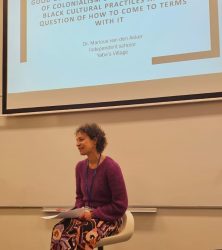
De vertelling ‘Good Culture, Bad Culture’. The Legacy of Colonialism’s Demonisation of Black Cultural Practices, and the Question of How to Come to Terms With It werd voorgedragen tijdens de 2025 KITLV Conferentie Transnational Conversations: Heritage, Memory, Climate and Reparatory Justice in the Carribean, Europe and Beyond.
I’m going to grab a chair and put it here. My body feels better sitting down, and I’m learning to listen to my body better. I will just sit here and tell a story. It’s such a shame that we largely lost the art of storytelling. I’m not a good storyteller myself, but I like to use occasions like these to practice. I don’t have a PowerPoint, only this one slide, to remind me that at one point I will have to say something that refers to my title. I don’t want to measure myself with the great speakers of our recent history but Marcus Garvey didn’t use PowerPoint, Malcom X didn’t use PowerPoint, Nelson Mandela didn’t use PowerPoint – and they all got their message across just fine. So let us not be tricked into thinking these props are a necessity.
I want to begin with saying that we are all sitting here as persons. Persons with joys, troubles, histories. The way in which I talk to you this afternoon, is entwined with who I am outside this room. Involuntarily I bring in my personality, my emotions, my fears. Whether I want to or not, I bring in parts of my childhood, my upbringing, my political preferences, my romantic life, and the things I haven’t been able to process yet. Here in this room lingers my divorce that just got finalised last week, my personal pain that as we speak I am the least favourite person in the world in the eyes of my six year old, and the fact that I got into such a serious fight with my employer that I’m currently paid to nót show up at the office. I can stand here, and tell myself to put all that aside for fifteen minutes, to just focus on what I promised what I would talk about, to perform ‘professionally’ in front of you. But the thing is, my body knows all these parts of me. And it does not only know parts of me, it also knows parts of what the people before me went through. It knows about the experiences and feelings of my ancestors. I’m not sitting here alone, beings are with me here in spirit and have my back. This is all in my body and my body cannot hide that. Bodies are bad liars.
Not so long ago, I attended a workshop at Wereldmuseum Amsterdam. It was a workshop that meant to present and practice together funerary dances of the Caribbean. It was an intense afternoon. The workshop leader, an acclaimed researcher in her field of study, danced choreographies that among others drew from Kumina, Vodou and Palo Monte. Some of the participants recently experienced losing someone dear to them and occasionally someone broke down, overcome by emotions. As the hours passed and the workshop approached its end, one of the black women in the group raised her hand to speak. She shared that she had found certain movements in the dances that we had practiced all afternoon, somewhat discomforting and confronting. Discomforting because she had been raised believing that moving the hips or the breasts in particular ways was understood to mark primitiveness and savageness. This was certainly not how her parents wanted her to behave, and she had internalised the conviction to stay far away from such gestures. And the afternoon had been confronting because here she was, enrolled in this workshop out of curiosity for mourning rituals that somehow connected to her own black cultural background, but than to experience that enacting such cultural practices brought about feelings of embarrassment and made her body resist. Immediately two or three other women gave voice to similar experiences. They as well had received such parental messages, and they as well had struggled that afternoon with a certain timidness or inhibition. The woman who was so brave to speak about this openly first, apparently had put her finger on a shared sore spot.
I think that what happened that afternoon in Amsterdam, is illustrative of a larger contemporary phenomenon – namely the tension between a timely desire to cherish and pass on (to younger generations) valuable cultural knowledge and practices on the one hand, and the discomfort or even shame that some of these practices and knowledge may induce on the other. To me, it reveals how sentiments saying ‘this cultural element is so valuable and important, we have to safeguard it’, may be somewhat at odds with (unconsciously) internalised ideas and convictions about the repulsiveness of that cultural element.
Now my title speaks of ‘black cultural practices’ in particular. I meant to use ‘black’ here as a political category, mobilised by colonial oppressors to signify inferior others. And with the words ‘good’ and ‘bad’, I meant to bring in imperial judgements about what was desirable behaviour and what not. I chose these three terms to draw attention to the ways in which colonial white agressors ridiculed, criminalised and sometimes outright prohibited cultural expressions
of the groups they subjected to their colonial tyranny. There are plenty of examples. Think for instance of winti, or tambu and kaseko. Think of a language such as Sranantongo, or particular healing methods and burial rituals.
Colonial worldviews, together with Christian conceptions and conversion missions, demonised such practices and knowledge systems. It aggressively threw at people that the pillars of their identity and of who they were as a collective, were expressions of barbarous and pagan idolatry. It brushed their ways of living aside as uncivilised behaviour and backward superstition. When Frantz Fanon began to talk of ‘colonisation of the mind’ in the 1950s, he wanted to make the argument that such toxic ideas and convictions came to be internalised by black bodies too, and he called for studying how that venom fosters a fractured sense of self. This is what went through my head, while I listened to the black women talking in the Wereldmuseum studio that afternoon. And I thought ‘yes, colonisation of the mind, but also colonisation of the body.’ Not in the strict sense of having your body physically controlled and abused by colonial occupying powers, but in the sense of how internalised colonial mindsets may trigger specific and very personal bodily responses.
Bodies have their own way of knowing. The thing is, when you have learned, whether through your individual upbringing or because society imprinted it on you, that you should tuck away parts of who you are, since those parts can hardly bear the light of day, you most probably will have difficulty to embrace and love everything you are – and your body knows this. When you have internalised that you are in some way unworthy and inferior – your body knows this. When you deep down think you do not deserve to be loved by another human being – your body knows this. And all that bodily knowing trickles down in most, if not everything, you do. Day in, day out.
By focussing on black cultural practices here, at this particular moment, during this particular conference, I in no way mean to suggest that colonial trauma, for that is how I would label this, is restricted to the descendants of the people formerly subjected to colonial cruelties only. I believe that colonial trauma resides too in the bodies of the descendants of formerly white oppressors. I believe colonial trauma resides in all of us. A question I often ask myself in that regard is: ‘What does it do to someone’s soul, to someone’s spirit, when you have been taught to dehumanise fellow people and grant yourself superior on the basis of racist lies? To what extend do you sacrifice your own humanity when you dehumanise another?’.
Back to the Amsterdam anecdote and the discomfort of some of the black women there. What our minds can rationally and intellectually grasp, and the ways in which our bodies behave, is not necessarily connected. Let me put it differently: we can put a lot of mental work in trying to understand how Frantz Fanon’s colonisation of the mind, or my own thoughts on colonisation of the body play out and cause harm, but coming to understand the mechanisms in itself does little to change them. The women in Amsterdam saw a connection between what they had been taught as a child and how their body responded that afternoon, but that in itself did not change their bodily sensations. Just like identifying a hammer as the source of pain that caused a broken finger, does very little to heal that finger.
But then what? What if we take serious the ongoing mental effects of the centuries-long circulation of judgements that black cultural practices are by and large backward, uncivilised, barbarous, pagan (in short, ‘bad’) – if we identify that now as a source of pain, then what do we need to do to heal that pain? I don’t have answers, but I have a gut feeling in which direction we may start looking.
That direction involves rediscovering everything we are as a human being. It involves rediscovering our full human potential. Enlightenment thinking and white Western science has been so successful in making the mind sole ruler. But our intellectual qualities are only a part of who we are and what we can do. We have our bodies, our soul, our spiritual potentials, our dreams that bring us messages and our ability to connect in ways that go beyond our understanding. I feel there can be no real reparatory justice when we do not first repair thát. If we not first awaken to all we can do and can be and develop the potential we have in us. So that we can begin to recover the essential, fundamental humanity in all of us that colonialism so effectively smashed.
“My body knows all these parts of me. And it does not only know parts of me, it also knows parts of what the people before me went through. It knows about the experiences and feelings of my ancestors. […] This is all in my body and my body cannot hide that. Bodies are bad liars.”